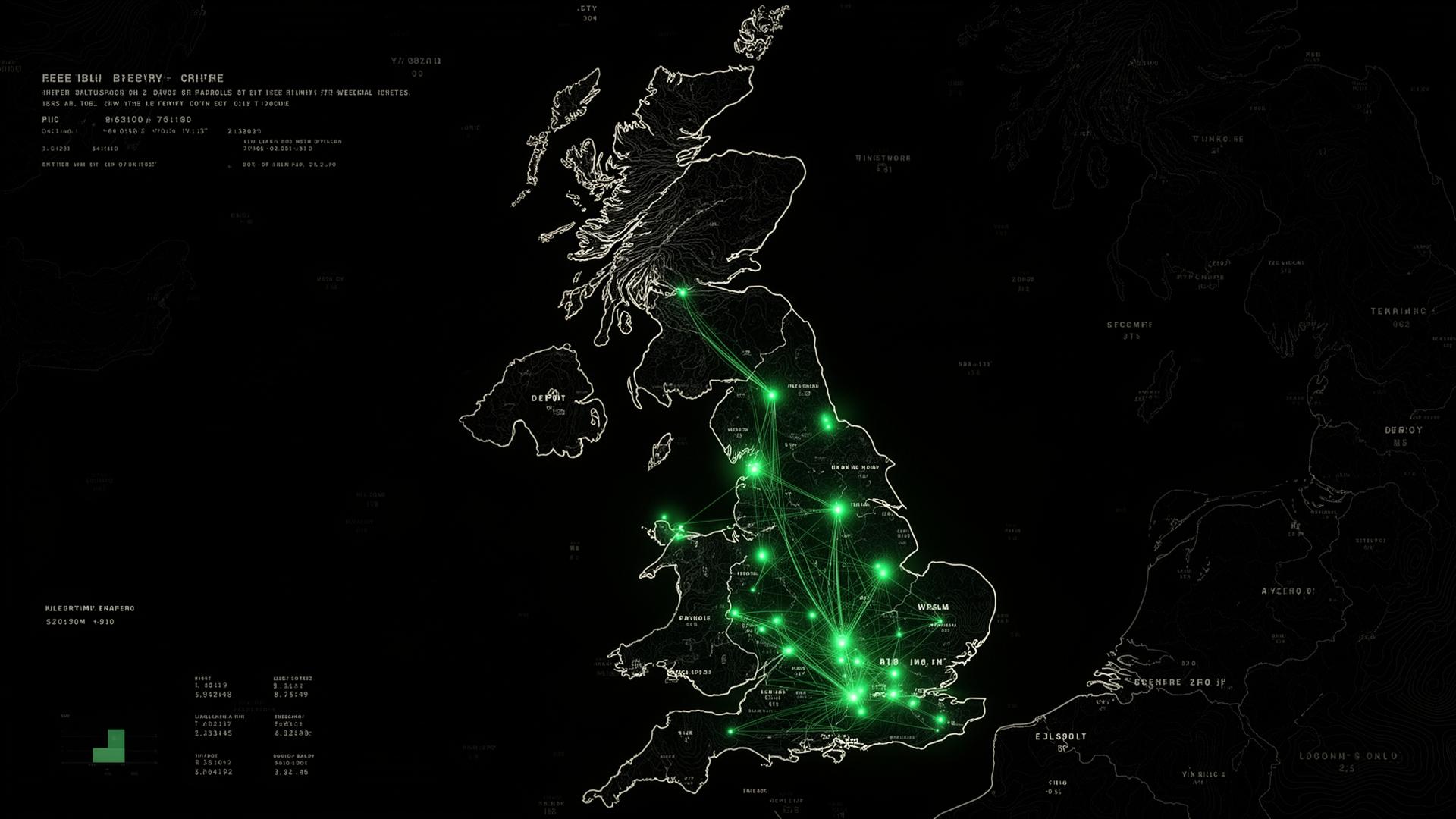
WX-CELL · GUSTS 22KTEDINBURGHGLASGOWNEWCASTLELEEDSMANCHESTERLIVERPOOLBIRMINGHAMBRISTOLLONDONSWANSEASOUTHAMPTONCAMBRIDGE
№ 001 · UK Network · 142 missions live

Operational infrastructure for rapid low-altitude logistics.

Corridor is the dispatch and routing network for urgent commercial items — line-down spares, pathology samples, telecom optics, scanner batteries, urgent tooling. Hybrid EV vans and short-leg drones, scored route by route, weather window by weather window. Built for warehouses, hospitals, utilities and ports.

Mission · CL-417 · in flightCC 91

Trafford Park DC → Salford Quays Warehouse

Payload · 6× barcode scanners (1.8 kg) · Line-down SLA

Drone ETA

6 min

Road ETA

31 min

Leg

5.4 km

Verified pad · 84 prior dispatches · EV fallback armed · Wind 12kt

WIND_SPEED 12KT · GUSTS 18KTMISSION CL-9921 · ACTIVECORRIDOR M1-NORTH-B · CONF 96.4%EV-VAN-1242 · DOCKED · BAT 88%VISIBILITY · OPTIMAL · CIG 4500FTLZ-BHX-04 · VERIFIED · CLEARFLEETBRAIN AIR · NOMINALLAT 51.5074N · LON 0.1278WLOW-ALT TRAFFIC · 14 ACTIVEINCIDENT FEED · 0 ALERTSWIND_SPEED 12KT · GUSTS 18KTMISSION CL-9921 · ACTIVECORRIDOR M1-NORTH-B · CONF 96.4%EV-VAN-1242 · DOCKED · BAT 88%VISIBILITY · OPTIMAL · CIG 4500FTLZ-BHX-04 · VERIFIED · CLEARFLEETBRAIN AIR · NOMINALLAT 51.5074N · LON 0.1278WLOW-ALT TRAFFIC · 14 ACTIVEINCIDENT FEED · 0 ALERTS

142

Active dispatches

38

Operational corridors · UK

27

EV launch hubs

96.4%

Avg. Corridor Confidence™

What Corridor moves

Small mass. High urgency. Short distances. Real money.

Corridor isn't replacing the lorry network. It's replacing the single-item van run that breaks the SLA — the urgent, low-mass items that today get a diesel driver, a parking ticket and 31 minutes in traffic.

Warehousing

Barcode scanners & line-down spares

Trafford Park DCSalford Quays warehouse

Drone

6 min

Road

31 min

Leg

5.4 km

Healthcare · campus

Pathology samples (refrigerated)

Manchester Royal InfirmaryWythenshawe lab

Drone

9 min

Road

42 min

Leg

8.2 km

Utilities

Substation control modules

Stockport depotReddish substation

Drone

5 min

Road

27 min

Leg

4.1 km

Telecoms

Mast-side telecom optics

Salford field hubEccles mast 4G/5G

Drone

7 min

Road

38 min

Leg

6.8 km

Construction

Specialist tooling between sites

Liverpool Docks workshopBootle industrial estate

Drone

6 min

Road

29 min

Leg

5.0 km

Emergency response

Pre-positioned support kits

Leeds operational baseBradford response unit

Drone

10 min

Road

44 min

Leg

9.6 km

Indicative routes from Corridor pilot models. Every dispatch is scored by FleetBrain Air before launch — weather, payload mass, landing zone history, EV fallback availability.

The dispatch flow

Request. Score. Dispatch.

Every Corridor mission flows through three operational stages. No black boxes, no algorithm shrugs — every routing decision is scored, logged and auditable by the trust, the insurer or the regulator.

Step 01POST /v1/missions

Dispatch request

Pickup, destination, payload class, urgency, SLA. Operator console or REST API. Sub-30s submission.

Step 02Corridor Confidence™ · 96.4

Route scoring

FleetBrain Air scores route viability — weather window, payload curve, landing-zone history, signal coverage, EV fallback.

Step 03EV-1242 · CL-417

Hybrid dispatch

EV van moves to the launch hub. Drone flies the short final leg. Telemetry logged end-to-end, ground fallback armed.

Proprietary systems

Four operational systems that only exist because Corridor exists.

Roads have maps. Airways have charts. Low-altitude logistics needs its own scoring, readiness, telemetry and network layer. We're building all four — and they only get more valuable with every dispatch.

CC · Proprietary

Corridor Confidence™

The credit score for autonomous logistics.

CC

A proprietary 0–100 score for any route, payload and weather window. Combines verified landing zones, prior dispatch success, battery curves, signal strength and incident history.

· Route confidence: 92

· 84 prior dispatches

· Verified pad · NE approach

· EV fallback armed

CR · Proprietary

Corridor Ready™

A readiness score for sites — and one day, addresses.

CR

Every warehouse, rooftop, hospital pad and (eventually) verified address scored on landing access, obstacle clearance, signal quality, weather exposure and delivery suitability.

· Landing clearance · A

· Approach safety · 93

· Weather exposure · 88

· Delivery confidence · 95

CT · Proprietary

Corridor Telemetry™

Ground-truth, not satellite guesses.

CT

Every flight logs weather reality, route success, battery degradation, signal conditions, failed approaches and landing issues. The dataset compounds. The dataset is the moat.

· Flights logged: 12,486

· Weather samples: 41k/day

· Approach outcomes captured

· Per-segment learning

CN · Proprietary

Corridor Network™

Verified pathways, not theoretical routes.

CN

A growing graph of trusted UK corridors with operational history, hub coverage, restricted-zone awareness and shared infrastructure — open one day to multiple operators.

· 38 active corridors

· 27 launch hubs

· Restricted-zone aware

· Operator-neutral by design

These are not features bolted on top of a drone fleet. They are the product. The aircraft are how we generate the data — the data is what compounds.

Hybrid operations

EV vans aren't transport. They're mobile launch hubs.

Our EV vans bring battery swap, signal relay, and roof-launch capability within 2 km of every destination — closing the infrastructure gap in industrial estates, hospitals, and rural sites.

  • Autonomous roof launch

    Drones deploy and recover from a stabilised pad.

  • Rapid battery swap

    On-board cells keep flight uptime above 98%.

  • Signal & telemetry relay

    Coverage in coverage-poor industrial sites.

  • Ground fallback

    If flight is grounded, the van completes the leg.

DRONE · CL-4 · ARMEDEV-VAN-1242 · BATTERY 88% · BIRMINGHAM
Operational reality

The sweet spot isn't cross-country. It's 4–12 km, repeated.

Cargo drones don't replace lorries. Payload halves range. Weather halves it again. The operationally honest unit isn't a 200 km flight — it's a short, repeatable leg between EV launch hubs. That's where the economics, the safety case, and the regulator all line up.

Small enterprise

2–8 km

Payload <2 kg

Documents, samples, single SKU spares.

Mid cargo (Corridor V1)

5–15 km

Payload 2–10 kg

Pathology, line-down spares, mast-side optics. Our sweet spot.

Heavy cargo

10–25 km

Payload 10–30 kg

Specialist tooling, marine resupply. Fewer corridors, higher approval cost.

How a Corridor mission actually flies

  1. Leg 01

    EV van moves near destination

    Battery anxiety eliminated. Drone stays cold until needed.

  2. Leg 02

    Roof launch from mobile hub

    Stabilised pad, signal relay, weather check at the launch point.

  3. Leg 03

    Drone flies the hard final leg

    Typically 4–12 km — beats traffic, avoids the unsafe approach.

  4. Leg 04

    Drone returns to van. Van moves on.

    Network compounds: telemetry logged, corridor scored, EV continues.

The real limit isn't battery — it's operational confidence. Can it land safely? What happens in wind? Is the corridor approved? Is there a ground fallback? Corridor is the layer that answers those questions before the drone leaves the van.

The strategic arc

Five phases. One layer.

Corridor doesn't start with consumer drones — that's the hardest version of the problem. We start where the routes are predictable, the landing zones are controlled, and the economics are real. Then we extend outward.

  1. Phase 01

    ● Live

    Commercial corridors

    Hybrid EV + drone dispatch on validated UK routes — warehousing, healthcare, utilities, ports.

  2. Phase 02

    ● Live

    Operational telemetry

    Every dispatch teaches the network — corridor confidence, weather impact, battery curves.

  3. Phase 03

    Roadmap

    Landing-zone intelligence

    Verified pad mapping, approach vectors, obstruction modelling, weather exposure scoring.

  4. Phase 04

    Roadmap

    Corridor Ready

    A landing-zone score for sites and (eventually) addresses — clearance, approach, confidence.

  5. Phase 05

    Roadmap

    Shared infrastructure

    Multi-operator routing, insurer-grade audit trails, regulator-ready operational record.

Phases 3–5 are deliberately quiet. The valuable layer underneath autonomous logistics isn't the aircraft — it's knowing which sites, rooftops and (one day) addresses are safe to land at, in what weather, with what confidence. Corridor is being built so that layer can exist when the world is ready for it.

Operator console

The view from the ops floor.

● Live

142

Active missions across the UK network

Tick 0042

96.4%

Average corridor confidence — last hour

Operations

Live mission queue, incident log, weather alerts and corridor state — the same view our pilots see.

Open the console →
Healthcare · the realistic path

We don't start by flying morphine across Manchester.

The NHS won't hand a national drug network to a startup — and shouldn't. The realistic path into healthcare is narrow, controlled and earned. Corridor is built for that path, not against it.

  1. Stage 01

    ● In pilot

    Campus transfers

    Single-site lab-to-lab, ward-to-pharmacy, pad-to-pad. Controlled airspace, repeated routes.

  2. Stage 02

    ● In pilot

    Inter-hospital pathology

    Time-critical samples between trust sites. Verified pads, EV fallback armed end-to-end.

  3. Stage 03

    Earned later

    Approved medical corridors

    Trust-wide routes with regulator-grade audit, chain-of-custody and incident telemetry.

  4. Stage 04

    Earned later

    Critical resupply

    Blood products, urgent low-volume meds. Only after years of operational record.

What healthcare actually buys

  • Chain-of-custody from pickup to landing
  • Tamper-evident payload, signed telemetry
  • Verified landing zone with pad-level history
  • Weather-adjusted dispatch, not optimistic flight
  • EV ground fallback armed on every mission
  • Incident log open to the trust, the insurer, the regulator

Cleaner urgent logistics — operationally, not as marketing

A diesel van crossing a congested city to move one blood sample is the worst unit economics in logistics — and the worst air quality outcome. Replacing those single-item runs with a short electric drone leg is faster, cheaper and lower-emission in that order.

Sample SLA
−42%

Door-to-door vs van

Cost per leg
−31%

Fewer driver-hours

CO₂ per leg
−86%

Electric · no idle

Indicative figures from Corridor pilot models

Phase 01 · what we're really building

Revenue is the byproduct. The dataset is the product.

Corridor's first thousand dispatches aren't about scale. They're about telemetry — building the operational record no one else has. Every flight teaches the network. Every landing scores a zone. Every corridor learns.

Flights logged

12,486

Per-segment telemetry, not regional averages.

Landing zones scored

847

Verified pads, rooftops and operational sites.

Weather samples / day

41,200

Cell-by-cell, corridor-by-corridor.

Incident outcomes

100%

Every WX-HOLD and ABORT feeds Corridor Confidence™.

Diesel miles avoided

38,400

Drone legs replacing single-item van runs across congested cities.

Demo figures shown. The principle is real: we build the data first — with operationally-pragmatic customers like warehouses, industrial estates, utilities and ports — and earn the right to serve healthcare and shared infrastructure later.

When ground transport breaks the SLA

Move it by air. Today.

Submit a delivery request and FleetBrain Air returns an operational feasibility analysis within seconds.